
What is a demand management program?
Demand management programs are compensated, temporary, and voluntary reductions of consumptive water use. Reductions in water use for agricultural purposes can take a number of forms, including fallowing fields, deficit irrigation, irrigation efficiency projects, switching to lower water use crops or decreasing water storage. Other kinds of water demand management programs in urban areas can include mandates to curb water use, offering subsidies for water efficient appliances and other rules and regulations.
- Colorado River District. (2021). Colorado River District Demand Management Stakeholder Advisory Committee Report. Colorado River District, Glenwood Springs, CO. https://crwcd.wpenginepowered.com/wp-content/uploads/2021/12/20200809-crd-dm-stakeholder-report-final.pdf
- Colorado River District. (2022). CRD Conceptual Market Structure For a Potential Demand Management Program In the State of Colorado. Colorado River District, Glenwood Springs, CO. https://crwcd.wpenginepowered.com/wp-content/uploads/2023/02/20220407-AAM-Memo-re-conceptual-Market-Structure-3.0.-DM-Memo-A.pdf
- Colorado River District. (2020). Demand Management. Colorado River District, Glenwood Springs, CO. https://www.coloradoriverdistrict.org/demand-management/
- Elena Maggioni. (2014) Water demand management in times of drought: What matters for water conservation. Water Resources Research, Volume 41, Issue 1, p. 125-139. https://agupubs.onlinelibrary.wiley.com/doi/abs/10.1002/2014WR016301
Why are demand management programs being considered?
The Colorado River Basin is facing a long-term water deficit. There is a clear relationship between rising temperatures and reductions in streamflow—research shows that for every one-degree Fahrenheit the average temperature rises, flows drop by 4-7%. Natural flows in the Colorado River have decreased by approximately 20% since the turn of the century, which has led to shrinking storage in Lakes Mead and Powell. New studies have shown groundwater depletion accounted for the loss of 71% of terrestrial water storage in the Lower Colorado River Basin and 53% in the upper.
- Karem Abdelmohsen, James S. Famiglietti, Yufei Zoe Ao, Behshad Mohajer, Hrishikesh A. Chandanpurkar. (2025) Declining Freshwater Availability in the Colorado River Basin Threatens Sustainability of Its Critical Groundwater Supplies. Geophysical Research Letters, Volume 52, Issue 10. https://agupubs.onlinelibrary.wiley.com/doi/epdf/10.1029/2025GL115593.
- Benjamin Bass, Naomi Goldenson, Stefan Rahimi, Alex Hall. (2023). Aridification of Colorado River Basin's Snowpack Regions Has Driven Water Losses Despite Ameliorating Effects of Vegetation. Water Resources Research, Volume 59, Issue 7. https://agupubs.onlinelibrary.wiley.com/doi/10.1029/2022WR033454
- Stephanie L. Castle, Brian F. Thomas, John T. Reager, Matthew Rodell, Sean C. Swenson, James S. Famiglietti. (2014). Groundwater depletion during drought threatens future water security of the Colorado River Basin. Geophysical Research Letters, Volume 41, Issue 16. https://agupubs.onlinelibrary.wiley.com/doi/full/10.1002/2014GL061055
- United States Bureau of Reclamation. (2021). Colorado River Basin Water Supply and Demand Study. United States Bureau of Reclamation, Washington, D.C. https://www.usbr.gov/lc/region/programs/crbstudy.html.
What does a demand management program for agriculture look like?
A clear example of a demand management program is the System Conservation Pilot Program, which ran in the Upper Colorado River Basin from 2015-2018 and 2023-2024. The first round of the SCPP was funded by state and federal sources, and the 2023-2024 programs was funded through the Inflation Reduction Act. The SCPP paid between $200 and $650 per acre foot of water conserved in Colorado, New Mexico, Utah and Wyoming in 2023 and from $300-$509 in 2024.
SCPP project administrators reviewed proposed water conservation projects considering a number of factors:
- Is there a history of recent consumptive use?
- Will the water get where it needs to go?
- Is there a need for shepherding and can it be shepherded?
- How much water will be saved?
- How easy is it to verify and account for the saved water?
- Are there multiple benefits for saving this water?
For program participants (water users), those questions and considerations were different:
- What are the economic realities of being compensated for reducing water use?
- How much administrative hassle is there?
- What will the soil/land look like if not watered and will there be long-term effects?
- What happens to the water being saved?
- What are the benefits of the program to Upper Basin users broadly?
- What if conserved water is used by other water users before it reaches its intended destination?
- Do Lower Basin water users get to use more water because of conservation in the Upper Basin?
- Upper Colorado River Commission. (2023). 2023 System Conservation Pilot Program (SCPP) Lessons Learned Summary. Upper Colorado River Commission, Salt Lake City, UT. http://www.ucrcommission.com/wp-content/uploads/2023/09/2023-System-Conservation-Pilot-Program-Lessons-Learned-Report-Public-Summary.pdf
How does demand management impact agricultural production?
Demand management programs for landowners can provide important compensation for economic losses from using less water. These programs can help producers bridge from more water-intensive crops or practices to less water-intensive operations. These programs are an alternative to “buy and dry,” the practice of buying farmland and its water rights and transferring that water to a municipal or industrial use, eliminating agricultural use entirely. Buy and dry has significant impacts on communities, wildlife and agriculture. Compensated conservation programs can make up for water supply deficits that result in reduced agricultural production or offset the costs of changing practices or updating infrastructure. Water lease payments areDemand management programs can functionally act as insurance against bad water years when agricultural operations have to operate at a deficit. Utilizing demand management programs to adapt to different irrigation and production techniques This style of irrigation can potentially leads to greater drought resiliency in plants according to some Western States Ranches research.
- Anmol Kalra, Shailendra Goel, Ani A. Elias. (2023). Understanding role of roots in plant response to drought: Way forward to climate-resilient crops. The Plant Genome, Volume 17, Issue 1. https://acsess.onlinelibrary.wiley.com/doi/full/10.1002/tpg2.20395
- Rattan Lal, Jorge A. Delgado, Jim Gulliford, David Nielsen, Charles W. Rice, R. Scott Van Pelt. (2012). Adapting agriculture to drought and extreme events. Journal of Soil and Water Conservation, Volume 67, Issue 6. https://www.tandfonline.com/doi/abs/10.2489/jswc.67.6.162A
- Bridget R Scanlon, Robert C Reedy, Claudia C Faunt, Donald Pool and Kristine Uhlman. (2016). Enhancing drought resilience with conjunctive use and managed aquifer recharge in California and Arizona. Environmental Research Letters, Volume 11, Number 3. https://iopscience.iop.org/article/10.1088/1748-9326/11/3/035013/meta
- Western States Ranches. Research Videos. Western States Ranches, Eckert, Colorado. https://wsranches.com/research/
Dive Deeper
| water, water technical document
Rock Weirs
Rock weirs are structures that act to slow water down in streams or ditches, decreasing erosion and creating habitat. Weirs offer low-tech solutions to issues that can plague landowners as they manage water crossing their land, and can be a powerful management tool. The strategic addition of rocks to streambeds creates turbulence and drag, which slows water down, reducing its capacity to carry sediment and erode the land. Weirs have been used as a water management tool for thousands of years, but the early 1900s saw a rise in their use for habitat and stream restoration.
Agricultural Water Users’ Preferences for Addressing Water Shortages in the Colorado River Basin
The Colorado River Basin is in crisis. There is no longer enough water for all of those who depend on it. The agricultural sector is the largest water user in…
Western water conservation and drought mitigation on private working lands
Policy opportunities in the farm bill and beyond The western United States continues to face extended and increasingly severe drought conditions that threaten municipal and agricultural water supplies, energy production,…
Water Rights in the West
Few things are as crucial to ranch operations as water. Getting a handle on your water rights may seem akin to drinking from a fire hose, but it is wildly important. Western water is complex, contentious, and rooted in rich history. This must-read article will help you keep your head above water.
| WOTUS
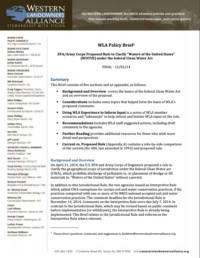
WLA Policy Brief on the Waters of the United States (WOTUS) Rule
This Brief consists of five sections and an appendix, as follows: Background and Overview covers the basics of the federal Clean Water Act and an overview of the proposal. Considerations…
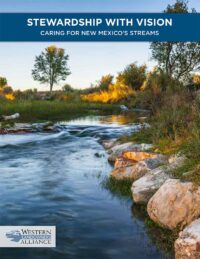
Stewardship with Vision
Caring for New Mexico’s Streams Private stewardship of Western land and water plays a vital role in the health of the West. This must-read guide highlights the importance of New…